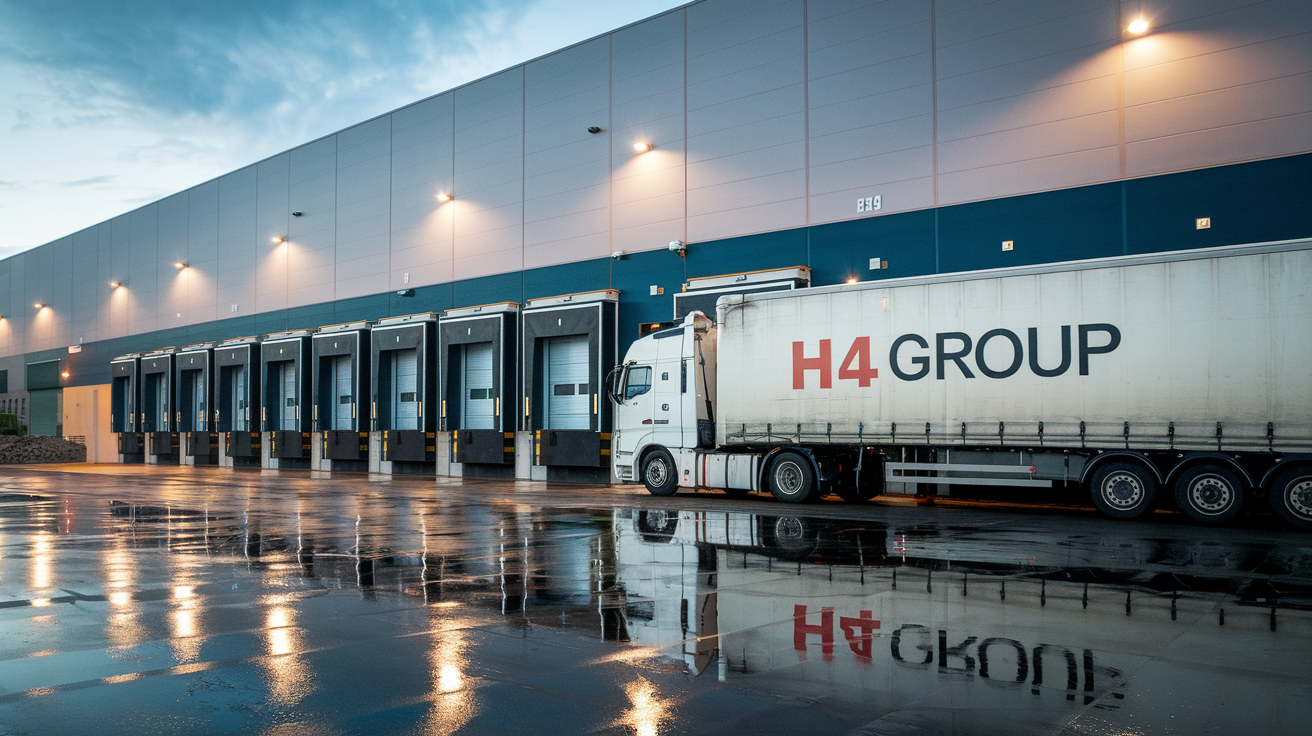
A warehouse is not a building in the way that an office block or residential scheme is a building. It is an operational machine. The height of the eaves, the depth of the yard, the number and configuration of dock doors, the ratio of office to warehouse content — these are not aesthetic choices. They are the criteria against which a logistics operator will decide whether to sign a lease.
Warehouse CGI that ignores this reality produces images that look impressive and secure nothing.
The operational brief:
Before a single model is built, a warehouse CGI brief needs to answer questions that have nothing to do with visual style. What is the clear internal height? What vehicle types will use the yard — articulated lorries require a minimum 50 metre yard depth for a safe swept path. Is there a gatehouse, a weighbridge, a sprinkler tank? Are dock levellers flush or raised? What is the ratio of HGV docks to level access doors?
These details determine whether a logistics director recognises your building as operationally viable or dismisses it within thirty seconds of seeing the CGI.
A studio that asks you these questions has worked on warehouse schemes before. One that doesn't is producing architectural impressions, not logistics marketing.
External views: what to show and what to leave out:
The hero external view of a warehouse serves two audiences simultaneously — the investor who needs to understand the asset quality, and the potential tenant who needs to understand the operational layout. These are different briefs and they pull in different directions.
For the investor, the emphasis is on build quality, specification, and context. Cladding finish, roof profile, landscaping, sustainable credentials — solar panels on the roof, EV charging in the car park, cycle storage. The building needs to read as a Grade A logistics asset.
For the logistics tenant, the emphasis is on the yard. Show the dock doors in context. Include an articulated lorry to give scale — this is one of the most consistently omitted elements in warehouse CGI, and its absence makes it impossible for an operator to assess whether the yard actually works. Show the gatehouse if there is one. Show the separation between HGV and car traffic if the site design provides for it.
The best warehouse CGI briefs produce two distinct external views: one yard-focused and operationally detailed, one elevation-focused for investor marketing.
Internal views and the fit-out question:
Warehouse interiors present a specific briefing challenge. An empty warehouse interior — concrete floor, steel frame, strip lighting — communicates very little to a prospective tenant. It needs to be dressed with operational content to become meaningful.
The question is how much fit-out to show and whose fit-out to imply. Showing racking immediately raises questions about racking type, height, and configuration — and different operators have completely different requirements. A food distribution operator and an e-commerce fulfilment operator have almost nothing in common in terms of internal layout.
The most commercially effective approach for a multi-let scheme is to show a partially fitted interior — enough operational content to convey scale and ceiling height, not so much that it implies a specific occupier type. For a single-occupier pre-let where you know the target tenant, show their operation as specifically as the brief allows.
The planning constraint most developers underestimate:
Warehouse developments at scale almost always attract planning scrutiny. The concerns are predictable: HGV movements and routing, noise from refrigeration plant or loading operations, visual impact on the surrounding landscape, and in Green Belt or edge-of-settlement locations, massing and cumulative impact.
The CGI produced for planning purposes must be technically accurate in a way that marketing CGI is not required to be. Accurate Visual Representations — tied to OS coordinates, produced to RICS or Landscape Institute standards — are the appropriate tool for Environmental Impact Assessments and planning appeals. Marketing images, however well-produced, will not satisfy a planning inspector who asks how the building will actually sit in the landscape from a specific public viewpoint.
Conflating these two briefs is expensive. Developers who instruct a studio to produce marketing images and then attempt to use them in a planning submission create problems that are difficult and time-consuming to resolve.
What the brief should contain:
A complete warehouse CGI brief covers: the full building specification including eaves height, floor loading, dock door count and type, yard dimensions and vehicle routing; the target tenant profile; the planning stage and whether AVR-standard visualisations are required; the investment audience and whether ESG credentials need to be visible; and the timeline, specifically whether pre-let marketing is running concurrently with the planning application.
That last point matters more than most developers realise. Images produced for pre-let marketing often show the scheme at its most optimistic — clear skies, full landscaping, immaculate yard. Images produced for planning need to show the scheme honestly within its context, including any visual impacts the planning authority is likely to scrutinise. Running both briefs simultaneously without separating them produces either compromised marketing imagery or inadequate planning evidence.
Thirty years of sheds:
H4 Group has been producing warehouse and logistics CGI since the late 1990s, when the sector was largely ignored by the visualisation industry as unglamorous work. It is now one of the most commercially active sectors in UK property, and the CGI brief has grown in complexity accordingly.
If you are preparing a warehouse CGI brief and want a second opinion before instructing a studio, we offer a no-obligation brief review. In our experience the thirty minutes spent at this stage routinely saves weeks of abortive work downstream.